






Crafting a Circular Destiny: Inside ‘Weave the Future 4.0’ and Manish Tripathy’s Radical Upcycling
The landscape of Indian fashion is undergoing a profound structural evolution. What once existed on the fringes of conceptual design—sustainability, material circularity, and raw upcycling has officially taken center stage, cementing itself as the core pillar of India’s textile future.
This monumental shift was perfectly captured at Dilli Haat, New Delhi, where the Ministry of Textiles inaugurated ‘Weave the Future 4.0: Upcycling Edition’. The event served as a powerful intersection where high-level national policy met the uncompromising artistry of avant-garde design, exemplified brilliantly by designer Manish Tripathy’s ‘Reclaimed Series.’
A National Mandate for Sustainable Innovation The fourth edition of this six-day national platform, organized by the Office of Development Commissioner (Handlooms), explicitly gathered over 100 brands, artisans, recyclers, and innovators to tackle the global challenge of textile waste.
During his high-profile visit to the exhibition, Union Minister of Textiles, Shri Giriraj Singh, made the stakes incredibly clear:
“As textile consumption continues to rise, it is imperative that we strengthen circular economy practices, promote responsible production, and scale innovative solutions that transform textile waste into valuable resources.”
Accompanied by key leadership, including Ministry Secretary Smt. Neelam Shami Rao and Development Commissioner Dr. M. Beena, the Minister emphasized that India is positioning itself as a global leader in resilient, eco-conscious textiles while simultaneously protecting the livelihoods of millions of grassroots workers.
The exhibition acted as an interactive ecosystem, featuring live demonstrations on material recovery, thrift collectives, and circular fashion dialogues. Yet, the true proof of this philosophy lay in the tangible creations on display, where abstract policy transformed into physical art.
Manish Tripathy’s ‘Waste to Wonder’: The Reclaimed Collection
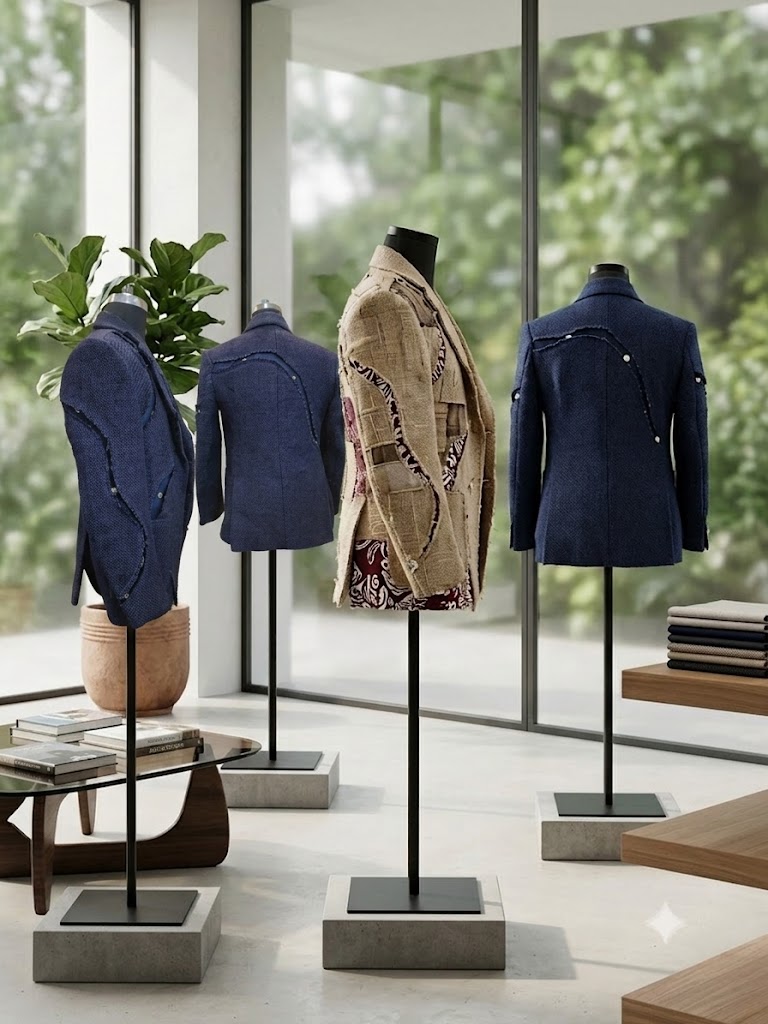
Standing as a definitive highlight of this movement is designer Manish Tripathy, whose contributions to the ‘Reclaimed Series’ perfectly mirror the exhibition’s vision of turning resource efficiency into pure luxury. The collection presents a powerful dual narrative of deconstructed tailoring, bridging rough industrial utility with rich, saturated elegance.
1. The Burlap Patchwork Blazer (Center)
● The Anatomy of Deconstruction: Rather than relying on traditional luxury textiles, Tripathy selected a profoundly humble, industrial material: burlap. Built from heavily distressed, open-weave upcycled burlap, the jacket features a raw patchwork technique. By leaving the raw edges exposed and preserving the frayed, chaotic texture of the fibers, Tripathy honors the material’s prior utilitarian life.
● The Underlay Contrast: The industrial grit of the burlap is balanced by a flawlessly tailored contrast. Beneath the rough, neutral-toned burlap layers, a vibrant maroon and white printed fabric emerges, establishing a striking visual dialogue between the organic, coarse exterior and the smooth, patterned lining peeking through intentional tears.
● The Structural Silhouette: Despite the chaotic nature of the fabric, the silhouette maintains the rigid, immaculate structure of classic bespoke tailoring, creating a stunning internal tension between elegance and decay.
2. The Indigo Textured Slashed Blazers (Left & Right)
● Materiality and Depth: Flanking the center piece are jackets crafted from a rich, deeply saturated indigo or midnight blue fabric. Woven from a heavy, highly tactile wool blend or coarse tweed, these garments offer a structured and premium textural foundation.
● Subversive Slashed Seams: The defining feature of the blue jackets is the radical, fluid slicing across the back and down the sleeves. Rather than standard functional seams, these curved, organic cuts slash through the garment to expose a smooth, lighter blue silk or satin lining underneath.
● Hardware as Anchors: The raw, frayed edges of these slashed seams are held together at calculated intervals by delicate, ornamental pearl or metallic button closures. This creates an elegant “slashed and pulled” effect reminiscent of historical garments, modernized through a contemporary, minimalist lens.
Redefining the Visual Narrative of Fashion The curated showcase space itself tells a story. Displayed on minimalist mannequins supported by heavy industrial concrete and rich wooden bases, the garments are treated with the reverence of museum artifacts. The overarching theme of this collection is the art of controlled chaos. Traditional tailoring relies on perfection, hidden structural canvases, and crisp, immaculate lines. Here, Tripathy subverts those rules, intentionally breaking down surfaces only to reassemble them with masterful precision.
Surrounding design elements, such as an open sketchbook lined with red thread, a ruler, and a book explicitly titled The Art of Deconstruction, pull back the curtain on Tripathy’s creative process. It proves to the viewer that upcycling is not a compromise or a happy accident; it is a meticulous, highly disciplined design framework. Placed alongside neatly folded, pristine luxury textiles, the message is undeniable: reclaimed materials deserve an equal seat at the high-fashion table.
As Dr. M. Beena noted during the event, the strong participation of young entrepreneurs and designers reflects an organic, generational shift toward conscious consumption. Upcycling is no longer just a reactionary measure against waste; it is an active celebration of history, texture, and resourcefulness.
Through the collaborative force of the Ministry of Textiles’ ‘Weave the Future 4.0’ initiative and the creative audacity of designers like Manish Tripathy, India is rewriting the rules of style. They prove that the future of fashion does not lie in creating something entirely new from scratch, but in having the vision to find wonder in what we once threw away.