







How to Compare GPU Cloud Providers Beyond Hourly Price
GPU cloud comparison tables often put one hourly number beside a GPU name. That can conceal whether the rate covers one accelerator or a complete multi-GPU machine, whether storage is included, whether capacity can be interrupted, and whether the configuration is available.
The best GPU cloud is workload-dependent. A researcher running a one-day experiment, a startup serving uneven API traffic, and an enterprise reserving a training cluster need different products. A defensible shortlist begins with an operating model, then tests cost with the real workload.
Compare the service model first
GPU providers generally expose one or more distinct models. An instance supplies a remote machine with operating-system, container, or SSH control. Serverless inference accepts requests and manages workers behind an endpoint. Managed model services add deployment, scaling, or model catalogs. Dedicated clusters emphasize reserved capacity, networking, and large-scale operations.
These options are not interchangeable. A custom CUDA extension may require an instance. Bursty inference may benefit from a serverless product that reduces idle capacity. Distributed training can depend on predictable multi-node topology and capacity commitments.
Ask each vendor exactly what the buyer controls: machine image, container, model, autoscaling policy, network, and lifecycle. Also identify what the provider operates. A higher managed-service rate can be economical if it removes engineering work the team would otherwise fund.
Verify the complete configuration
The GPU model is only one line of the specification. Record GPU count and VRAM variant, CPU cores and architecture, system RAM, local and persistent storage, network bandwidth, and interconnect. For multi-GPU work, determine whether NVLink or another fabric is present and how devices are arranged.
Do not assume several GPUs act as one memory pool. Training and serving software needs tensor, pipeline, data, or expert parallelism suited to the topology. A cheap machine can be unusable if it lacks memory, feeds data too slowly, or cannot support the intended distributed strategy.
Confirm drivers, CUDA range, container support, ports, and access method. Run the same immutable workload image during vendor trials.
Normalize pricing and billing
Before comparing rates, label each offer as on-demand, spot or interruptible, reserved, serverless, or dedicated. Note the billing unit, minimum duration, rounding, startup charges, stopped-instance storage, and termination behavior. Serverless products may meter seconds, tokens, images, or other usage rather than machine-hours.
Build a total estimate that includes:
- compute during startup, processing, and idle periods;
- persistent disks, snapshots, and model storage;
- data transfer and cross-region traffic;
- IP, load-balancing, orchestration, or support charges;
- engineering time for deployment and maintenance;
- wasted work after interruption or failure.
Then compare cost per successful output: a completed checkpoint, one million generated tokens under a latency target, or a batch of processed images. A more expensive accelerator can have lower unit cost if it finishes substantially faster and stays utilized. The reverse is true when a premium GPU waits idle.
Examine capacity and lifecycle behavior
A catalog entry does not guarantee inventory. Ask how current availability is represented, whether an API exposes it, whether capacity can be reserved, and what happens when provisioning fails. For production, test launch times and error behavior rather than relying only on documentation.
Lifecycle semantics affect automation. Determine when billing begins and ends, how termination is confirmed, and whether create operations support idempotency. If an API request times out, the client needs a way to discover whether a machine was created before retrying.
Evaluate region coverage per GPU class. Match locations to users, datasets, residency requirements, and failover needs. Confirm the compute region rather than inferring it from company headquarters.
Assess the developer and operating experience
The first launch is only a small part of the product. Review API and command-line coverage, image and template workflows, SSH or console access, logs, metrics, budget controls, team permissions, secret handling, audit records, and status communication.
For serverless inference, inspect model support, request schema, streaming, concurrency limits, cold starts, autoscaling controls, cancellation, and observability. Do not assume an endpoint is compatible with a familiar SDK merely because its payload resembles it.
Security evaluation should cover scoped credentials, network exposure, encryption, retention, tenancy, incident reporting, and deletion. Enterprise buyers may also need contractual commitments, compliance evidence, and an escalation path.
How major provider categories differ
RunPod combines GPU Pods, container-oriented Serverless endpoints, and cluster products. Its developer emphasis makes it relevant to teams comparing controllable instances and autoscaling workers in one ecosystem.
Vast.ai operates a marketplace with many hosts and configurations, using on-demand, interruptible, and reserved options. Buyers may find broad choice, but should evaluate the individual listing’s machine, host, reliability context, and price rather than treating every offer as identical.
Lambda focuses on AI-oriented GPU cloud and cluster infrastructure for training and inference. CoreWeave targets AI-scale compute with GPU infrastructure, Kubernetes, storage, networking, and managed or dedicated inference. Fluidstack and Crusoe are also relevant to teams seeking large dedicated deployments or managed cluster engagements.
Together AI is centered more on model consumption and deployment, offering serverless and batch inference, dedicated endpoints, fine-tuning, and clusters. It belongs in a shortlist when the desired product is a managed inference platform rather than simply an SSH-accessible machine.
DigitalOcean and Paperspace combine GPU capabilities with a broader developer-cloud context. AWS, Google Cloud, Microsoft Azure, and Oracle Cloud pair accelerated compute with extensive identity, networking, storage, managed data, and procurement ecosystems. That breadth can simplify integration for existing customers, while machine families, quotas, commitments, and ancillary pricing require careful normalization.
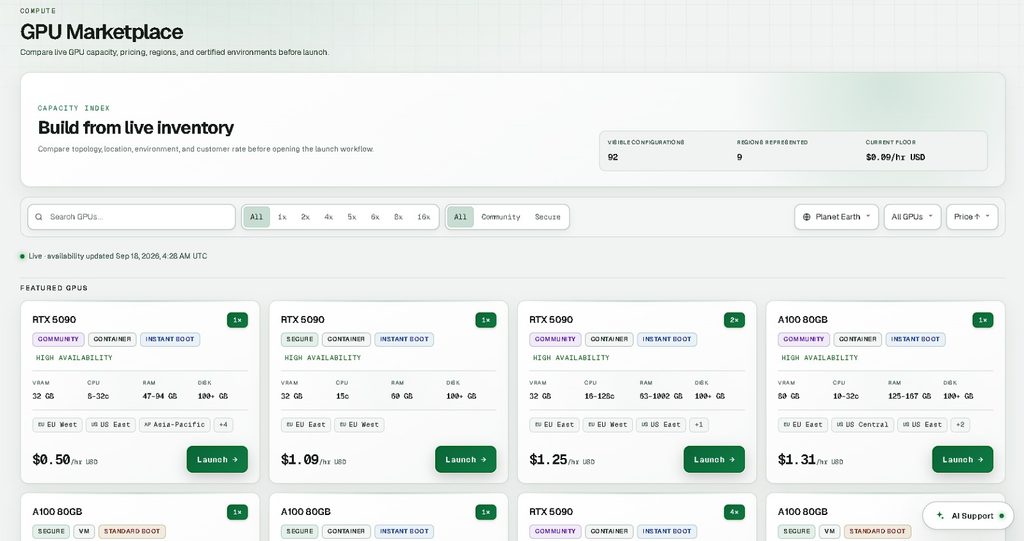
Hostnot GPU separates GPU Instances from Serverless AI and publishes synchronized machine configurations in its GPU Marketplace. Buyers can inspect current availability, regions, and complete-machine rates at https://hostnotgpu.ae/gpus, then compare those live offers using the same requirements applied to other platforms. Availability and rates can change, so the launch-time listing remains authoritative.
Run a representative proof of concept
Create a scorecard before trials. Weight hard gates such as VRAM, region, security, and framework support separately from preferences such as console design. Eliminate options that fail a hard requirement.
On the remaining providers, run the same model, image, dataset sample, precision, and load profile. Measure provisioning time, correctness, peak memory, throughput, p95 and p99 latency, failure behavior, and cost for the full test window. Include model download and environment setup if they will recur in production.
Test teardown and billing records too. Save outputs to durable storage, terminate resources, and confirm the recorded usage. Contact support with a realistic technical question; response quality is difficult to infer from a feature page.
Conclusion
Comparing GPU cloud providers is an exercise in matching infrastructure to a workload, not finding the smallest isolated hourly number. Service model, complete-machine specifications, regional capacity, billing semantics, APIs, security, and operational support all shape value.
Use public rates to form a shortlist, but choose from reproducible tests and cost per useful output. The resulting decision may use one provider for experiments, another for managed inference, and committed infrastructure for stable demand. That is often more realistic than naming one universal winner.