





Why Some Agencies Are Prioritizing Decision Clarity Over Reach
Across recent campaigns, a pattern is starting to appear.
Not loud. Not widely discussed yet.
But consistent enough to notice if you look closely.
Campaigns with strong reach are not always translating into stable decisions.
At the same time, a smaller set of campaigns — sometimes with less visibility — are converting with more consistency.
The difference does not seem to be budget, platform, or even targeting.
It appears to be something quieter.
The Old Assumption That Still Drives Most Campaigns
For a long time, the working logic has been simple:
More reach leads to more clicks.
More clicks lead to more conversions.
So campaigns are structured around:
- expanding audiences
- improving CTR
- increasing frequency
On the surface, this still works.
But somewhere between the click and the decision, something starts to weaken.
Not dramatically.
Just enough to affect outcomes.
Where That Assumption Begins to Break
In several campaign audits across different categories — interiors, services, D2C — the early signals often look stable.
Traffic arrives.
Engagement appears healthy.
But movement slows down after that.
Users pause.
Sessions shorten.
Lead quality fluctuates.
Nothing seems “wrong,” yet the system doesn’t move forward cleanly.
The issue is not visibility.
It’s what happens once visibility turns into evaluation.
The Shift Toward Decision Clarity
Some agencies have started responding to this not by pushing more traffic, but by adjusting what sits around the decision moment.
The focus moves from:
- how many people see the campaign
to:
- how clearly a user understands what to do next
This includes subtle shifts such as:
- aligning tone across ad and landing
- removing unnecessary messaging layers
- making the next step feel obvious rather than optional
It is less about persuasion and more about reducing friction.
What Actually Changes in the Mechanism
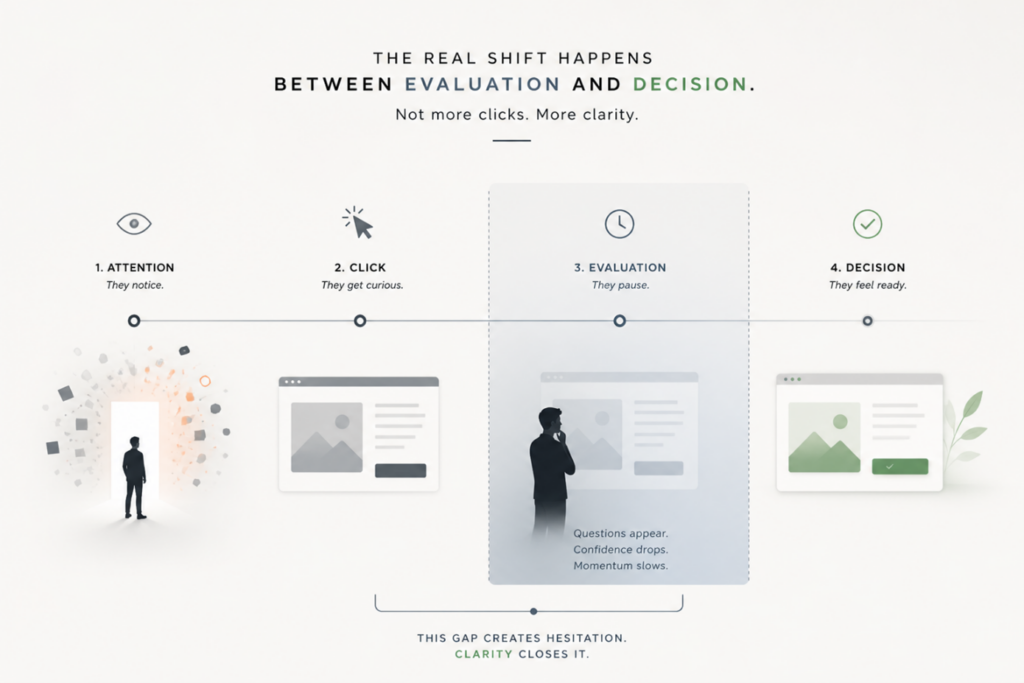
The most noticeable difference shows up in the middle of the funnel.
The path is still:
attention → click → evaluation → decision
But the emphasis changes.
Instead of optimizing the first step, the system is tuned around the last two.
In practical terms:
- the ad no longer promises more than the landing can deliver
- the landing does not introduce new uncertainty
- the message stays consistent throughout
A small example helps.
In one interior services campaign, early creatives were clean and visually balanced.
Traffic was steady, but users often exited before taking action.
After adjustments, the visuals became slightly less controlled — expressions more natural, framing less symmetrical — and the landing was simplified.
The volume of traffic did not change significantly.
But user movement did.
People spent slightly longer.
Navigation became more direct.
Decisions felt less hesitant.
The change was not dramatic.
It was smoother.
A Brief Reference Point
A similar direction can be observed in how some boutique studios are approaching campaigns.
In one published breakdown, Mogedochi described focusing less on scaling ads early and more on stabilizing user behavior first.
The emphasis was on consistency between creative, message, and landing experience.
The original discussion can be explored here:
https://mogedochi.com/why-ads-dont-work-anymore/
This is not unique to a single studio, but it reflects a broader shift in thinking.
Behavioral Response: What the User Actually Feels
From the user’s side, this shift is subtle.
They do not consciously notice alignment or clarity.
They feel something else.
- less hesitation
- fewer second guesses
- a quieter sense of certainty
Most decisions are not blocked by strong rejection.
They are slowed down by mild uncertainty.
A sentence that could describe this moment:
People rarely say no. They simply don’t feel ready to say yes.
Reducing that gap seems to be where these newer systems are focusing.
A Pattern Across Campaign Types
This is not limited to one category.
Across different campaigns:
- a D2C product launch
- a service-based funnel
- an interior design lead system
The same pattern appears.
When the gap between expectation and experience narrows:
- user movement becomes more predictable
- conversion stabilizes
- performance becomes less volatile
This suggests that the shift is not tied to industry, but to structure.
Broader Signals From the Industry
This direction is also loosely reflected in wider industry discussions.
For example, conversations around smaller, highly aligned teams and creative systems — such as those covered in
https://www.exchange4media.com/marketing-news/ai-the-future-of-creativity-the-four-person-agency-154147.html
— point toward a move away from scale-first thinking.
Similarly, case-driven storytelling approaches seen in agency work like
https://www.schbang.com/casestudies/mentos-made-a-mast-gen-z-comeback-clocked-36m-reach
highlight how narrative and clarity often shape outcomes as much as reach.
These are not identical approaches, but they share a common thread:
systems matter more than isolated tactics.
Where This Leaves Reach
Reach is still relevant.
Without visibility, nothing begins.
But it no longer guarantees momentum.
Instead, it acts as an entry point.
What determines the outcome is what happens after attention has already been earned.
Closing Observation
The shift toward decision clarity does not replace traditional metrics.
It sits underneath them.
Campaigns that appear similar on the surface can behave very differently once users begin evaluating them.
And the difference, increasingly, seems to come from how clearly the path forward is presented.
Not louder messaging.
Not wider reach.
Just a cleaner decision.