







One Click View: Advanced Website Audit Tool For GEO, AEO, and AI Search Optimization
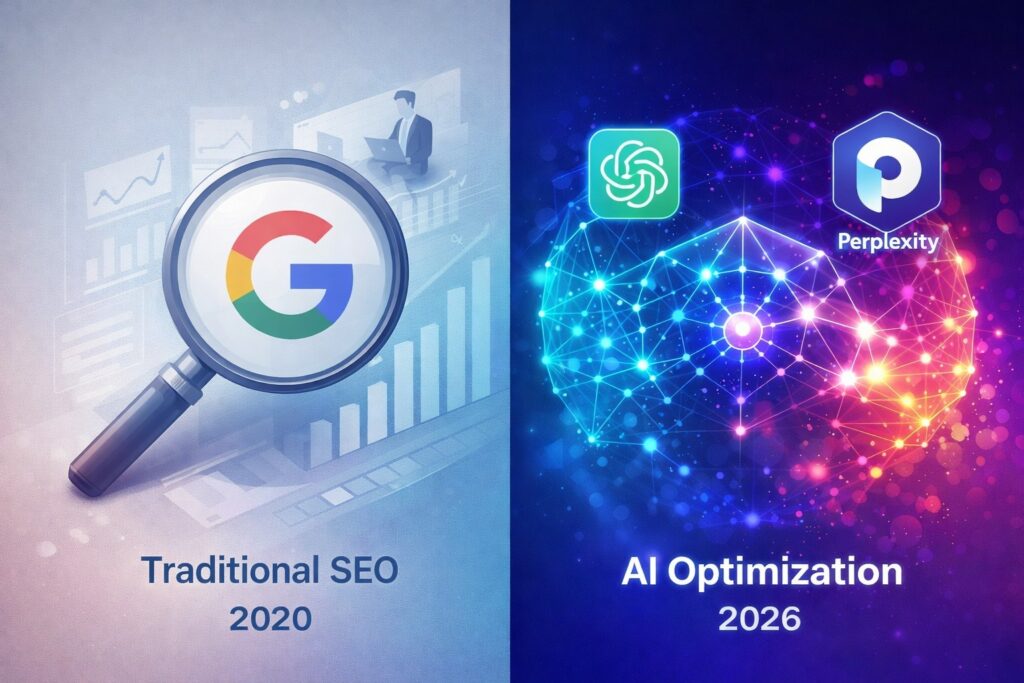
The digital landscape is currently undergoing its most significant transformation since the invention of the search engine itself. For years, the gold standard for visibility was a top-three spot on the Google search results page. However, as we move through 2026, the goalposts have shifted. We are no longer just optimizing for humans clicking links; we are optimizing for machines that synthesize information. To remain relevant, brands must master a new trinity: Generative Engine Optimization (GEO), Answer Engine Optimization (AEO), and AI Search Optimization.
The Evolution: From Blue Links to AI Synthesis
In the traditional SEO era, success was measured by how well you could convince a crawler that your page was the most relevant “destination.” Today, search engines like Google and Bing, along with LLM-native platforms like Perplexity and ChatGPT, act as “Synthesizers.” Instead of sending a user to your website, they read your website, summarize the content, and present the answer directly to the user.
This shift has birthed Generative Engine Optimization (GEO). GEO is the strategic process of making your content easily “findable” and “citeable” by Large Language Models. If an AI doesn’t see your data as structured or authoritative, your brand effectively ceases to exist in the conversational search layer.
What Makes a Strategy GEO and AEO Friendly?
To capture the “Zero-Click” searches and AI citations, your content structure must change. Answer Engine Optimization (AEO) focuses on the “what,” “why,” and “how.” It targets the immediate need of the user.
1. The Power of Directness
AI models prioritize clarity. When you use a free SEO website audit tool, one of the first things you should look for is your “Direct Answer Ratio.” Every H2 or H3 heading in your article should be followed by a concise, 40-60 word summary. This serves as a “hook” for AI models to extract and display in an AI Overview or a voice assistant response.
2. Structured Data and Schema Markup
You cannot have a successful AI search optimization strategy without a technical foundation. Schema markup acts as a roadmap for AI. By using Article, FAQ, and How-To schemas, you are speaking the native language of generative engines. This reduces the “hallucination” risk for the AI, making it more likely to credit your site as a factual source.
The Role of the “Free SEO Website Audit Tool” in 2026
Many marketers make the mistake of thinking traditional tools are obsolete. On the contrary, a free SEO website audit tool is more critical than ever, but the metrics have evolved. When performing an audit today, you aren’t just looking for meta tags; you are looking for:
- Semantic Density: Does your content cover a topic deeply enough for an AI to consider you an expert?
- Crawl Accessibility: Are you blocking AI bots (like GPTBot or Google-Other) in your robots.txt?
- Entity Association: Does the tool show that your brand is clearly associated with your target keywords in the “knowledge graph”?
Using these tools to identify gaps in your technical SEO ensures that your GEO efforts aren’t being sabotaged by backend errors.
Bridging the Gap: AI Search Optimization for Competitive Niches
AI search optimization is the bridge between traditional rankings and AI citations. To win here, you must move beyond simple keyword stuffing. AI models look for “information gain”—the inclusion of new, unique facts or perspectives that aren’t found in every other article on the web.
Strategies for High Visibility:
- Cite Sources Constantly: Strangely, AI models are more likely to cite you if you cite others. It builds a web of trust.
- Use Data Visualizations: Tables and lists are the “fast food” of AI learning. They are easy to parse, easy to copy, and highly likely to be featured in a “comparison” style AI response.
- Expert Opinions (E-E-A-T): Authoritative content backed by real-world experience is harder for AI to mimic, making it more valuable as a training source.
The “Disruptive” Edge: Why Authority Matters
Posting on a platform like Disruptive Spotlight (DA – 42) is a strategic GEO move in itself. AI engines weigh the “Domain Authority” and “Trust” of the platform where the content lives. A well-optimized article on a DA 42 site has a significantly higher chance of being used as a reference for an AI Overview than the same article on a brand-new blog.
By leveraging high-authority backlinks and combining them with AEO-style formatting, you create a “visibility loop.” Higher authority leads to more AI citations, which leads to more brand mentions, which ultimately boosts your traditional SEO rankings.
Conclusion: Preparing for the Post-Search World
The future of digital marketing is conversational. Whether a user is typing a query into a search box or asking a voice bot for a recommendation, the underlying technology is looking for the most structured, authoritative, and direct answer available.
By integrating a free SEO website audit tool into your monthly routine and pivoting your content toward generative engine optimization, you aren’t just keeping up with the trends—you are future-proofing your digital footprint. The era of the “blue link” isn’t over, but it is no longer the only game in town.